Outrage as Child Predator Seeks Political Office in California
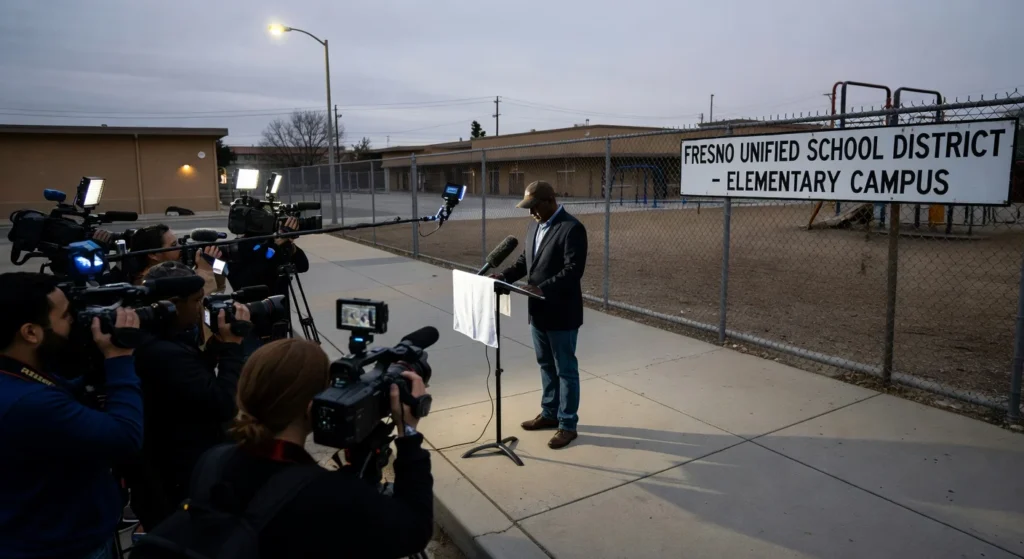
Rene Campos, a Fresno City Council candidate and registered sex offender facing child pornography charges, held a press conference right outside an elementary school in Fresno, California. This bold move not only drew immediate scrutiny but also forced school officials to file a police report, underscoring significant lapses in public safety protocols. According to reports, Campos chose a location perilously close to the school’s playground, where children were present during recess, raising alarms about potential risks to minors. The press conference was intended to discuss his campaign platform, but the choice of venue sparked outrage, as it appeared to directly challenge the restrictions imposed on registered sex offenders.
This incident spotlights Campos’ troubling choice to stage his event near children, likely flouting California’s strict laws for sex offenders. Under Penal Code Section 626.8, individuals on the sex offender registry are prohibited from loitering within 100 feet of school grounds without a legitimate purpose, a rule designed to safeguard vulnerable populations. Despite these clear guidelines, Campos proceeded, possibly under the guise of political activity, which experts argue does not exempt him from such restrictions. School leaders acted swiftly by alerting local law enforcement, demonstrating the immediate threats his candidacy poses to families in the area and highlighting how his actions could inadvertently expose children to harm.
Campos has a serious criminal history that raises red flags for his run for office. Records show that he was convicted several years ago for possession of child pornography, leading to his inclusion on California’s Megan’s Law registry. This registry requires offenders to disclose their addresses and prohibits them from residing or lingering near schools, parks, and other child-centric areas. His decision to enter politics adds a layer of complexity, as it forces the community to confront whether someone with such a background should influence public policy. Legal experts point out that while Campos has the constitutional right to run for office, his alleged violations could lead to parole revocation or additional charges, making his campaign a precarious gamble that endangers public trust.
Social media erupted after Libs of TikTok shared the story, with users slamming how Campos got away with this in a family-focused city like Fresno. The original tweet, posted on March 4, 2026, quickly amassed thousands of retweets and comments, many from parents and conservative activists expressing disbelief and fury. Phrases like “How is this even allowed?” echoed across platforms, amplifying the sense of betrayal among residents who expect their elected officials to prioritize child safety. Local news outlets, such as ABC30 Action News, further fueled the backlash with their report titled “Registered sex offender seeks to join race for Fresno City Council,” which detailed eyewitness accounts of the press conference and interviewed community members demanding stricter vetting processes for candidates.
This case exposes flaws in enforcing laws that keep offenders from child-heavy zones, as California’s buffer zone requirements are meant to be a deterrent but clearly weren’t effective here. Political analysts suggest that the incident reveals a broader issue in local elections, where background checks for candidates are often inconsistent. For instance, experts from organizations like the National Center for Missing and Exploited Children have weighed in, stating that allowing a registered sex offender to campaign near a school sets a dangerous precedent. They argue that such oversights could encourage similar behavior elsewhere, potentially leading to more violations and endangering communities nationwide. In Fresno, this has prompted calls for immediate reforms, including mandatory reviews of criminal records for all political aspirants.
From a conservative view, stories like this reveal the risks of weak oversight in local races, where everyday folks suffer most. Parents in Fresno are outraged, with some organizing rallies to protest Campos’ candidacy, emphasizing that letting him near a school undermines the very fabric of community trust in government. Child advocacy groups, such as those affiliated with conservative think tanks, are pushing back hard, demanding that election boards implement rigorous screenings to prevent future incidents. Public reaction has been swift, with petitions circulating online to disqualify Campos and pressure officials to enforce existing laws more stringently, reflecting a growing sentiment that redemption should not come at the expense of children’s safety.
Moving forward, this could trigger probes into Campos’ campaign and similar issues statewide, potentially leading to his disqualification or even criminal prosecution. Election officials in Fresno may face intense scrutiny for approving his candidacy without thorough checks, which could result in policy changes at the municipal level. Long-term implications include the possibility of new legislation in California to bar individuals with certain convictions from holding public office, a move supported by experts who warn that unchecked participation by offenders could erode faith in democratic processes. For instance, legal scholars have noted that this case might inspire court challenges to existing laws, balancing First Amendment rights against public safety concerns, and could influence how other states handle offender reintegration.
In the bigger picture, this reflects ongoing clashes over rights versus safety, a hot topic for conservatives who prioritize protecting families above all. While advocates for criminal justice reform might argue for second chances, the proximity of Campos’ press conference to an elementary school is seen as a flagrant disregard for societal norms, demanding decisive action. It’s not just about one candidate—it’s about shielding families and ensuring that local leaders are trustworthy, as voters in Fresno grapple with the fallout. This event has sparked broader discussions on social media and in conservative circles about the need for enhanced monitoring of sex offenders, including GPS tracking or community notifications, to prevent such occurrences.
At the end of the day, Campos’ press conference near that elementary school is reckless and unacceptable, as the police report and public fury prove. This should jolt Fresno and other places to enforce laws protecting children more rigorously, perhaps by increasing funding for law enforcement oversight or establishing dedicated task forces. The incident serves as a stark reminder that without vigilant measures, similar risks could arise in other communities, ultimately risking the loss of faith in our institutions. As the story continues to unfold, it’s clear that accountability must be the cornerstone of any response, ensuring that the safety of the most vulnerable remains paramount in our political landscape.